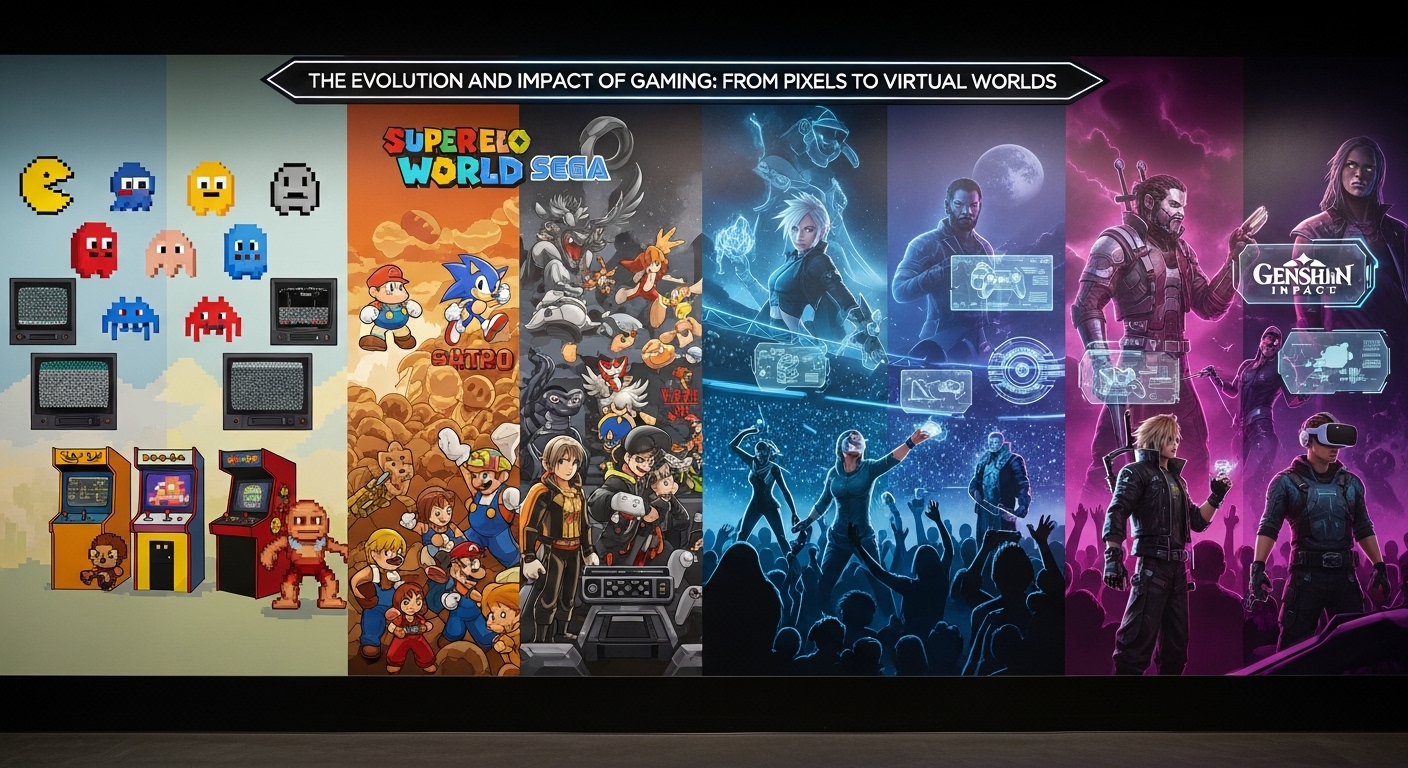
Gaming is more than just a hobby. It is a living, breathing universe of creativity, competition, and connection. From the beeping pixels of the past to the vast open worlds of today, gaming has evolved into one of the most powerful mediums of entertainment, art, and technology. What once began as a simple escape from reality has become a global culture, shaping generations and redefining how humans interact with machines, stories, and each other.
The Birth of Play: From Pixels to Passion
The story of gaming begins in the humblest of ways — with lights flickering on screens and the echo of mechanical sounds filling early arcades. In the 1970s and 1980s, games were simple in design but grand in imagination. Pong was nothing more than two rectangles and a dot, yet it created the foundation for an entire industry. Space Invaders, Pac-Man, and Donkey Kong followed, capturing hearts with their charm and challenge.
What made these games remarkable wasn’t just their technology but their ability to create joy out of simplicity. A single joystick, a few buttons, and a glowing screen could transport players into another world. It wasn’t about the graphics or storylines; it was about play — that universal instinct to test, compete, and win.
As the years passed, gaming consoles made their way into homes. The Nintendo Entertainment System, the Sega Genesis, and the PlayStation became household names. Children gathered in living rooms, battling digital enemies and sharing laughter. Gaming slowly stopped being just a pastime; it became part of family life, part of culture, and part of growing up.
The Golden Age: When Worlds Expanded
The 1990s were a golden era for gaming. Technology began to catch up with imagination. For the first time, developers could build worlds that felt alive, characters that had depth, and stories that mattered. Games like The Legend of Zelda: Ocarina of Time, Final Fantasy VII, and Super Mario 64 showed that gaming could be more than a quick thrill — it could be emotional, cinematic, and unforgettable.
Players no longer simply controlled characters; they lived their stories. They traveled across fantasy kingdoms, fought for justice, and discovered the power of narrative within interactivity. Every decision, every battle, every victory felt personal. It was during this time that gaming truly became art.
PC gaming also flourished, introducing genres that would define the future: strategy games like Age of Empires, first-person shooters like Doom and Half-Life, and online worlds like Ultima Online. The internet was changing everything. Suddenly, games weren’t just single experiences; they were shared universes.
The Rise of Online Play: A New Kind of Connection
When the internet became fast and accessible, gaming transformed forever. Multiplayer experiences took center stage, and competition reached new heights. Titles like Counter-Strike, StarCraft, and later World of Warcraft redefined what it meant to play together. No longer limited by geography, players from across the globe could meet, cooperate, and compete in real-time.
Online gaming gave birth to entire communities. Friendships formed through headsets, alliances were built across continents, and rivalries turned into lifelong memories. For many, these digital spaces became a second home — a place where identity could flourish without boundaries.
However, it wasn’t just about the fun. Online gaming also revealed the power of teamwork, communication, and perseverance. In virtual battlegrounds, players learned leadership, strategy, and adaptability — skills that often carried into real life.
The rise of online gaming also led to the birth of esports. What began as casual competitions among friends evolved into massive tournaments with millions of viewers and professional players earning global fame. Games like Dota, League of Legends, and Counter-Strike turned gaming into a legitimate spectator sport. Today, esports arenas fill with cheering fans, and digital athletes train with the same discipline as traditional sports professionals.
The Era of Immersion: Realism and Storytelling Unite
As technology continued to advance, so did the art of immersion. The early 2000s to 2010s witnessed a revolution in graphics, storytelling, and game design. Consoles became more powerful, PCs became more versatile, and developers began pushing the boundaries of what was possible.
Games such as The Last of Us, Red Dead Redemption, and Skyrim redefined the emotional and visual scope of the medium. These titles offered breathtaking landscapes, complex characters, and stories that could rival Hollywood films. Yet, unlike movies, players were not passive spectators — they were active participants shaping the journey.
The emotional power of gaming became undeniable. Players cried over character deaths, celebrated victories with genuine joy, and pondered moral choices that blurred the line between right and wrong. Games like Mass Effect and The Witcher 3 gave players agency over narrative outcomes, making every decision carry weight.
Virtual reality also emerged during this period, offering players the chance to step directly inside their favorite worlds. Although still evolving, VR represented the next leap in interactivity, blurring the boundaries between real and virtual life.
The Power of Community: Gaming as a Global Language
One of the most beautiful aspects of gaming is its ability to connect people from every corner of the world. It transcends language, culture, and background. Whether someone is in Tokyo or Toronto, gaming offers a common ground — a universal form of expression and communication.
Online platforms have made gaming more social than ever before. Streamers, content creators, and influencers have built entire careers around sharing their gameplay experiences. Millions of people watch live streams daily, not just for entertainment but for companionship. In many ways, gaming has become a shared ritual of the digital age.
Communities form around specific games, genres, or even fan art and mods. These spaces often act as creative incubators where players exchange ideas, stories, and inspiration. From fan-made expansions to game mods that become cultural phenomena, such as those seen in Minecraft or Skyrim, gaming communities have proven that players are not just consumers — they are creators.
The Indie Revolution: Creativity Without Limits
While big studios produce blockbuster titles, independent developers have sparked a new revolution. With fewer resources but boundless imagination, indie games have become a powerful force in the industry. These smaller projects often experiment with storytelling, mechanics, and emotion in ways mainstream games cannot.
Titles like Undertale, Hollow Knight, Stardew Valley, and Celeste have shown that games don’t need massive budgets to create meaningful impact. Indie developers remind the world that gaming’s heart lies in creativity and sincerity, not just profit or spectacle.
Indie gaming also represents the democratization of development. With tools like Unity and Unreal Engine available to the public, anyone with passion and skill can bring their vision to life. It has opened the doors to diverse voices, stories, and perspectives that make gaming richer and more inclusive.
The Social Mirror: What Games Teach Us About Ourselves
Beyond entertainment, gaming reflects society’s values, struggles, and hopes. It mirrors the world we live in, while also offering a glimpse of what could be. Many modern games explore complex themes — identity, morality, loss, politics, and survival. They invite players to think, to feel, and to question.
Games like Life is Strange, Detroit: Become Human, and Papers, Please explore ethical dilemmas and human emotion in ways few other mediums can. They force players to confront choices and live with the consequences. In this sense, gaming has matured, becoming a mirror for our collective consciousness.
Moreover, gaming can be therapeutic. Studies have shown that games can reduce stress, improve cognitive skills, and even help with mental health. For many people, gaming serves as both escape and expression — a safe space to be themselves, to explore identities, and to find comfort in virtual companionship.
The Shadows of the Industry: Challenges and Controversies
Of course, the gaming world is not without its challenges. Issues like crunch culture, online toxicity, and microtransactions have sparked debate and criticism. As gaming becomes more commercialized, questions arise about ethics, fairness, and creativity.
Toxic behavior in online games has often tarnished the sense of community that gaming should foster. Developers and players alike continue to seek ways to make online spaces more inclusive, safe, and respectful. Meanwhile, the industry faces scrutiny over exploitative practices, such as loot boxes and aggressive monetization strategies that blur the line between entertainment and gambling.
Yet, even amid these struggles, the spirit of gaming persists. Every year, new creators rise, players demand change, and the community evolves. The heart of gaming remains in its players — in their passion, feedback, and resilience.
The Next Frontier: Artificial Intelligence and Virtual Realities
As we look to the future, gaming stands at the frontier of technological innovation. Artificial intelligence is reshaping how games are built and experienced. NPCs are becoming smarter, worlds are becoming more adaptive, and stories are being personalized to each player’s decisions.
Imagine a world where every playthrough is truly unique — where the game learns from your behavior, remembers your actions, and evolves accordingly. This is no longer science fiction; it is rapidly becoming reality.
Meanwhile, virtual and augmented reality continue to expand, offering deeper immersion. The concept of the “metaverse” — a shared, persistent digital universe — is gaining traction. In this space, gaming, social interaction, work, and creativity may one day merge seamlessly. Players won’t just visit virtual worlds; they’ll live in them.
Cloud gaming also promises a revolution in accessibility. With powerful servers handling computation, players can stream high-quality games on any device, breaking the barrier between hardware and experience. This could make gaming more inclusive, giving everyone, regardless of income or platform, a chance to explore digital worlds.
The Human Heart of Gaming: Why We Play
At its core, gaming is about connection — to others, to stories, and to ourselves. We play not just to win, but to feel, to explore, and to dream. Whether battling dragons, building cities, or surviving apocalyptic wastelands, players find meaning in the worlds they inhabit.
Games give us control in a chaotic world. They let us rewrite destiny, conquer fear, and experience triumph. They offer a place where failure is never final, where learning is part of play, and where imagination reigns supreme.
For some, gaming is a way to escape. For others, it’s a way to express. But for all, it’s a reminder of the human spirit — the desire to create, to challenge, and to connect.
The Future Awaits
The future of gaming is infinite. As technology grows and creativity expands, new possibilities will emerge that we can barely imagine today. Perhaps games will one day simulate entire universes with living, evolving societies. Perhaps they’ll merge with our daily lives through augmented reality. Perhaps they’ll teach us empathy, culture, and philosophy in ways schools never could.
But no matter how advanced gaming becomes, its essence will remain the same — play. The simple joy of interaction, the thrill of discovery, and the satisfaction of mastery will continue to drive this art form forward.
Gaming has come a long way from the blinking lights of arcades and the cartridges of the past. It has become a reflection of who we are and who we aspire to be. It is an art form, a community, a challenge, and a dream — all wrapped into one.
As long as humans crave adventure, curiosity, and connection, gaming will never fade. It will continue to evolve, to inspire, and to bring people together. The console may change, the graphics may improve, and the technology may advance, but the spirit of gaming — that spark of imagination — will always endure.